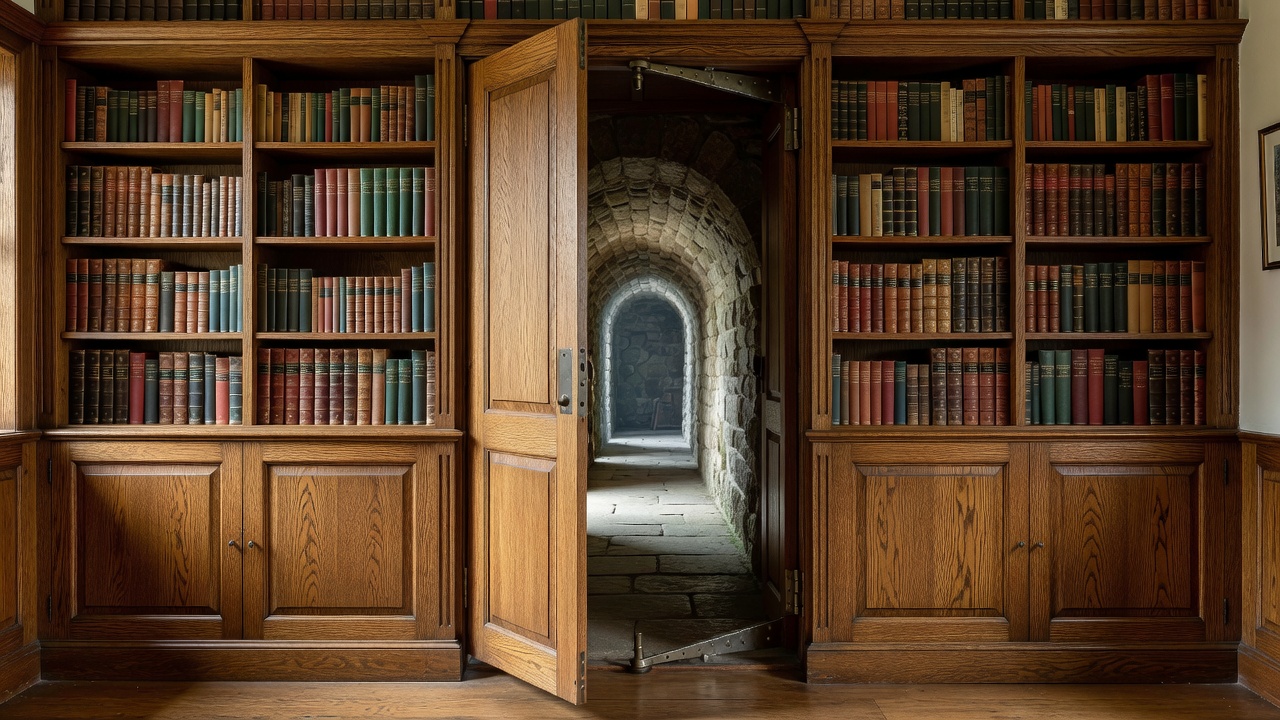
During the American Prohibition Era of 1920–1933, clandestine drinking establishments known as speakeasies relied on physical deception to survive federal inspections. Among the most sophisticated mechanisms was the double-hinged heavy oak bookcase door, engineered to carry hundreds of pounds of literature while operating with absolute silence and zero floor drag.
The Engineering Mechanics of the Secret Hinge
Standard door hinges are mounted on the side jamb, causing heavy doors to sag over time—especially when burdened with solid wood shelving and hardcover books. Prohibition architects solved this by inventing top-and-bottom heavy-duty steel pivot hinges embedded directly into the structural ceiling beam and subfloor joists.
By placing the pivot axis 4 to 6 inches inward from the side frame rather than flush on the edge, the weight of the bookcase was counterbalanced. This allowed a 500 lb loaded bookcase to swing open with less than 3 lbs of manual force.
Technical Blueprint Specifications
The Trigger Switch: The Book Pulley System
The secret latch mechanism was traditionally concealed inside a dummy book—often bound in heavy leather like The Count of Monte Cristo or Encyclopedia Britannica Vol. IV. Pulling the top spine of the designated book pulled a hidden steel aircraft cable routed through the interior shelf framing, releasing an iron spring-latch embedded into the wall frame.
If federal agents inspected the bookcase without releasing the latch, the wall remained completely rigid and sounded entirely solid when knocked upon.